


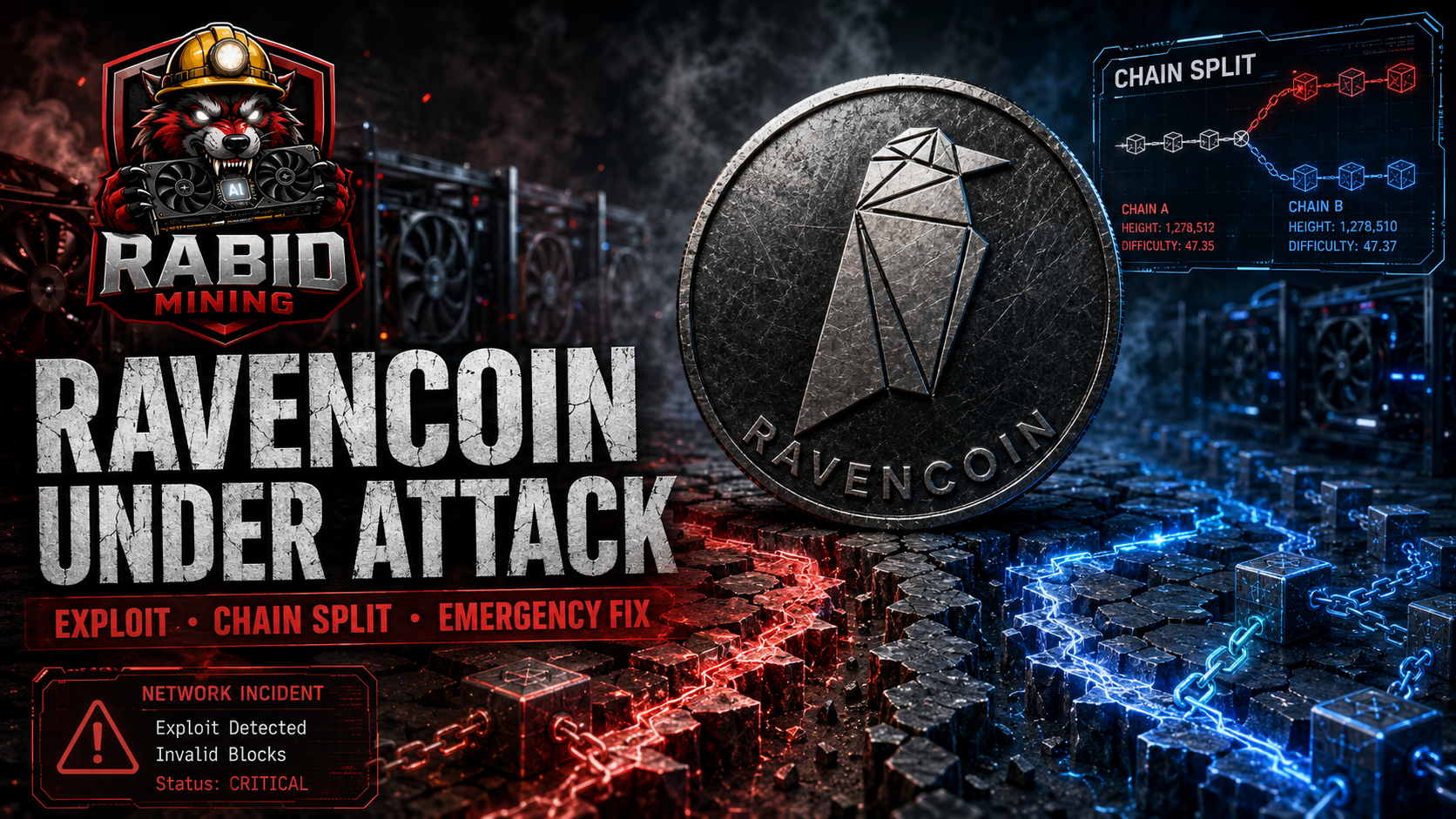
An actively exploited Ravencoin consensus flaw has allowed malformed blocks onto the network, caused node synchronization problems, and pushed 2Miners to release its own emergency fix and roll the blockchain back to the last known clean block.
By Rabid Mining — August 10, 2026
Ravencoin is dealing with a serious network-level security problem after a flaw in its KAWPOW proof-of-work validation was actively exploited on mainnet.
This is not simply a pool outage or a miner submitting a few bad shares. The vulnerability affects the way Ravencoin determines whether a block has performed the proof-of-work it claims to have performed.
According to an investigation and emergency software release published by 2Miners, exploitation began on August 7, 2026, and malformed blocks have continued appearing in the chain.
The situation has now become serious enough that 2Miners has released its own patched Ravencoin client and started mining a replacement blockchain from the last block it considers clean.
The official Ravencoin account has also acknowledged the issue.
What Actually Happened?
Ravencoin uses the KAWPOW mining algorithm, a GPU-oriented proof-of-work system based on ProgPoW.
Inside a KAWPOW block header is a value describing the block’s height.
The problem is that Ravencoin was not adequately verifying that the height declared inside the KAWPOW header actually matched the block’s real height in the blockchain.
That opened the door to a very unusual attack.
Ravencoin uses checkpoints and optimized validation for older blocks so nodes do not need to repeatedly perform the full expensive KAWPOW calculation for blockchain history that has already been established.
According to 2Miners, an attacker discovered that a new block could lie about its height and trigger this cheaper validation path.
That means an attacker could produce a block that nodes accepted without performing the complete memory-hard ProgPoW work normally required by KAWPOW.
In simple terms:
The attacker found a way to make Ravencoin believe expensive GPU mining work had been performed when it had not.
That is a consensus-level problem.
The Attack Is Already Happening
This is not a theoretical vulnerability that researchers discovered before anyone could use it.
2Miners identified what it considers the first exploited block as:
Block 4,487,776
August 7, 2026 — 15:44:01 UTC
The previous block:
4,487,775
is being treated by 2Miners as the last known clean block.
2Miners also analyzed a section of the affected blockchain between blocks 4,489,527 and 4,491,615.
Out of 2,089 blocks examined, it says it found:
96 malformed blocks
That is approximately:
4.6% of the sampled blocks
or roughly:
one affected block every 22 blocks.
That is far beyond somebody experimenting with the exploit once or twice.
Someone appears to have been repeatedly using it.
Why This Is More Serious Than Cheap Mining
The attacker potentially being able to obtain block rewards without performing the real KAWPOW workload is already a major problem.
But the malformed blocks create another problem that may be even more damaging to the network.
They can break Ravencoin nodes.
When one of the exploited blocks first arrives, the node can validate it using the false height contained in the block header.
However, Ravencoin’s block database also knows where that block actually belongs in the chain.
When a node restarts and reconstructs that information, the real blockchain height can be used instead of the fraudulent one.
Suddenly the block no longer validates correctly.
Affected nodes can reportedly encounter errors including:
Error loading block database
and fail to start normally.
Nodes Can Also Have Trouble Catching Up
Ravencoin nodes that fall behind the network may face another problem.
Because malformed blocks contain inconsistent height information, reconstructed block headers may no longer match what following blocks expect.
That can produce errors such as:
non-continuous headers sequence
A node trying to synchronize may begin rejecting or penalizing peers that are actually sending it the blockchain those peers believe is valid.
That means this vulnerability doesn’t just affect mining rewards.
It can interfere with something fundamental:
Ravencoin nodes being able to restart and synchronize with the network.
2Miners Released Its Own Emergency Fix
Rather than wait for an official Ravencoin Core release, 2Miners created and published:
Ravencoin Core 4.6.1.1-hf1
The emergency version introduces several changes designed to stop the exploit and recover affected nodes.
Most importantly, starting at block 4,487,776, the height declared inside the KAWPOW header must match the block’s actual height in the blockchain.
If it does not match, the block is rejected.
2Miners also added:
Block 4,487,775
as a new checkpoint.
That represents the last block before the first exploit it identified.
The emergency client can also remove bad block-index records, discard broken descendants, rebuild chainstate when necessary and rebuild Ravencoin asset databases that may otherwise conflict during the recovery process.
But 2Miners Did More Than Patch the Bug
This is the most important part of the story.
2Miners did not simply say:
“From this block forward, we reject the exploit.”
Its emergency client rejects the exploited history beginning at block 4,487,776.
That means patched nodes fall back to:
Block 4,487,775
and begin building a replacement blockchain from there.
In other words:
Ravencoin is facing an emergency blockchain rollback and chain split.
The blockchain containing the exploited blocks continues to exist on nodes that still accept it.
2Miners, meanwhile, is mining an alternative chain where those blocks never happened.
Two Ravencoin Histories Are Now Competing
When AllFather checked the live network data during the incident, the difference between pools was enormous.
2Miners was showing a Ravencoin height around:
4,488,165
while F2Pool was reporting approximately:
4,491,972
That is a difference of roughly:
3,800 blocks.
Those snapshots were not necessarily captured at the exact same second, but a difference of thousands of Ravencoin blocks cannot be explained by ordinary network propagation.
It strongly indicates that different infrastructure is following incompatible blockchain histories.
One chain contains the blocks 2Miners considers exploited.
The other rejected them and began again from block 4,487,775.
What This Means for Ravencoin Miners
For RVN miners, pool choice suddenly matters much more than usual.
Normally, choosing between large pools mostly affects things like:
- fees
- payout method
- server location
- minimum payout
- luck
- reliability
During a chain split, the pool can also determine:
Which blockchain your GPUs are actually securing.
2Miners is clearly supporting its repaired chain.
Other pools may still be following the original history unless they update their Ravencoin software and agree to the same fork rules.
Miners should verify which chain their pool is supporting rather than assuming every RVN pool is currently on the same blockchain.
What Is the Official Ravencoin Team Doing?
When this issue first surfaced, one of the major concerns was the lack of an immediate official response.
That has now changed.
The official Ravencoin X account has acknowledged the incident.
That is important, but acknowledgement and releasing a coordinated consensus fix are two different things.
At the time of this article, Ravencoin’s official GitHub release page still listed:
Ravencoin Core v4.7.0
released on June 14, 2026
as the latest official release.
The emergency 4.6.1.1-hf1 client is a 2Miners-maintained release, not an official RavenProject release.
The next major step will be seeing whether Ravencoin developers endorse the same repair rules and the same rollback point.
Is This a 51% Attack?
Not in the traditional sense.
A normal 51% attack happens when someone obtains enough legitimate proof-of-work hashrate to overpower honest miners.
This situation is different.
The attacker appears to be exploiting a flaw in how Ravencoin validates KAWPOW itself.
Instead of obtaining enormous legitimate GPU hashrate, the attacker discovered a way to make certain blocks appear acceptable without performing all of the computational work Ravencoin expects.
That makes this a consensus-validation vulnerability, rather than simply someone renting enough GPUs to overpower the network.
Are Ravencoin Wallets Being Drained?
Nothing in the technical information reviewed by Rabid Mining indicates that this vulnerability exposes:
- seed phrases
- private keys
- hardware wallets
- wallet encryption
So this should not be described as someone hacking people’s Ravencoin wallets.
There is also no confirmed evidence in the information we reviewed that the attacker has directly drained ordinary RVN holders using this exploit.
The danger is instead focused on:
block validity, proof of work, chain reorganizations, mining rewards, confirmations and determining which blockchain history will survive.
What Happens to Transactions After the Rollback?
This is where things become complicated.
If the wider Ravencoin ecosystem eventually agrees that the 2Miners chain is correct, then blocks after 4,487,775 on the abandoned chain would effectively be orphaned.
That does not automatically mean every normal transaction made during that period is permanently lost.
Many transactions can potentially return to the mempool and be mined again into the new chain.
However, their original confirmations disappear.
Mining rewards from orphaned blocks are different.
If a block does not exist in the final accepted blockchain, its coinbase mining reward does not exist there either.
Transactions that depend on outputs that only existed on the abandoned blockchain could also become invalid.
This is why exchanges, pools and users need to be extremely careful with recent confirmations until the Ravencoin ecosystem settles on one canonical chain.
What Needs to Happen Next?
Ravencoin now needs coordination between:
Core developers
Mining pools
Exchanges
Explorers
Node operators
Miners
The biggest questions are now:
Will RavenProject officially adopt the 2Miners fix?
Will block 4,487,775 become the agreed rollback point?
Will the major mining pools move onto the patched chain?
Which chain will exchanges recognize for deposits and withdrawals?
Will an official Ravencoin Core emergency release be published?
What happens to blocks, transactions and mining payouts created during the affected period?
If everyone quickly converges on one set of rules, Ravencoin can reunify around one blockchain.
If major pools, developers or exchanges disagree about the recovery plan, the chain split could become much more complicated.
Rabid Mining Summary
This is far more serious than a temporary mining-pool problem.
Ravencoin’s security is based on the idea that producing a valid KAWPOW block requires miners to perform a real amount of expensive GPU computation.
The exploit discovered on the network appears to violate that assumption.
According to 2Miners, exploitation began at block 4,487,776 on August 7, and its investigation found 96 affected blocks among 2,089 blocks examined.
The malformed blocks can also interfere with node startup and synchronization.
2Miners responded by releasing its own emergency Ravencoin client, enforcing correct KAWPOW block heights and rolling its blockchain back to the last clean block:
4,487,775.
Its miners are already building a replacement chain.
Meanwhile, other infrastructure has continued reporting a blockchain thousands of blocks ahead, indicating that the Ravencoin network has effectively split between incompatible histories.
The official Ravencoin account has acknowledged the problem, but the critical question now is whether the Ravencoin development team, exchanges and remaining mining pools will all agree on the same fix and rollback.
Until that happens, Ravencoin miners and users should treat the network as being in an active emergency recovery situation.
Rabid Mining will continue following the situation as the network determines which chain survives.
Sources
2Miners Ravencoin Emergency Fix — v4.6.1.1-hf1
https://github.com/2miners/Ravencoin/releases/tag/v4.6.1.1-hf1
Official Ravencoin Statement
https://x.com/Ravencoin/status/2086862580014850412?s=20
Original Community Report
https://x.com/t_allfather/status/2086763063777087798?s=20
Official Ravencoin Core Releases
https://github.com/RavenProject/Ravencoin/releases
2Miners Ravencoin Pool
https://rvn.2miners.com/
F2Pool Ravencoin Page
https://www.f2pool.com/coin/ravencoin
Rabid Mining
Crypto Mining • AI Compute
Published August 10, 2026. This is an actively developing situation. Blockchain heights, pool support, software versions and official guidance may change after publication.