


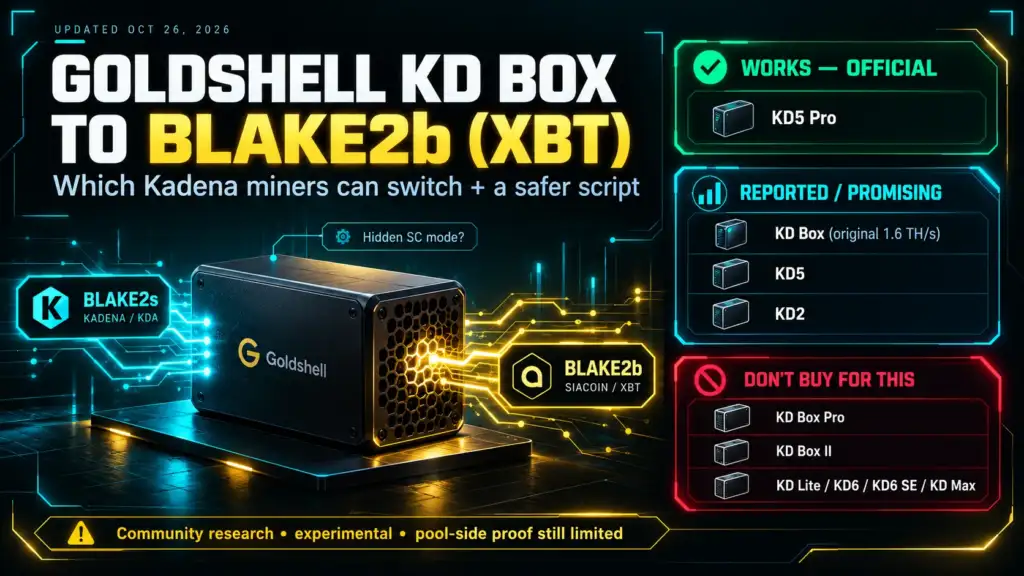
Can your Kadena miner mine BLAKE2b?
The new Bitcoin BLAKE2b chain (XBT) made BLAKE2b miners valuable. Some Goldshell Kadena boxes can switch to it. This KD Box BLAKE2b guide covers what is actually known, sorted by how solid the proof is.
Have an original KD Box? Jump to the safer script ↓
Current as of 26 October 2026. This is moving fast and things could change at any time. More support is likely to come later, with new firmware, more models and more proof from the community, so check back. We will update this post as it does.
Works — officially
Reported working / promising — not proven yet
No — or don’t buy one for this
What is going on with KD Box BLAKE2b
Two math recipes. Kadena miners run BLAKE2s; Siacoin and the new XBT Bitcoin chain run BLAKE2b. Same family, but 2b uses bigger 64-bit numbers and 2s uses 32-bit. A chip built only for 2s normally can’t do 2b.
Why now. In August 2026 the XBT chain switched its mining to BLAKE2b, so BLAKE2b miners jumped in value and old Kadena boxes selling for ~$40 suddenly look interesting.
The twist. Goldshell’s older Kadena chip ICA586 is listed as BLAKE2s, but the same chip ships inside Goldshell’s SC5 Pro II, which is a BLAKE2b miner — so that chip can do both. Goldshell unlocked it officially on the KD5 Pro. The older KD boxes are thought to carry the same chip, with a Siacoin mode hidden in Goldshell’s own miner program. The script just turns that mode on.
Why newer boxes can’t. The KD Box Pro and KD Box II appear to use a newer chip ICA585 that is BLAKE2s only, and their stock firmware locks SSH so you can’t easily get in to try. Half speed on the ones that work (~0.8 vs 1.6 TH/s) fits the bigger 64-bit math.
KD Box II root access. A community project, jeditrunks/kdbox-ii-root on GitHub, describes getting root SSH on a stock KD Box II (firmware 2.2.7) by flashing a custom signed image through the miner’s own update page. It says outright that it does not change what the hardware can hash: the ICA585 chips are BLAKE2s only, so this gives you access, not BLAKE2b. It also warns that the flash wipes your pool settings and resets the admin password, and that a bad image can leave the box needing physical console access. We have not tested it, so read its README before trying anything.
Before anyone tries it — the part people skip
- Fan and overheat protection stop. The script pauses the box’s own controller, so automatic fans and the thermal cutoff stop working. Screenshots show 93 °C against Goldshell’s 86 °C cutoff. Run fans at full and watch temps, or use a version with its own heat shutoff.
- Only old firmware has SSH (about 2.2.0 and older). Newer boxes are locked; getting in means opening the case.
- Set a static IP in the box first. After the script, a reboot can make the box lose its IP and drop off the network (reported by the community). Give it a fixed IP in its own network settings before you start.
- The shared script has a stranger’s pool worker in it. Change the pool to your own before running, or you mine for him. The version below has blank pool fields for yours.
- A hashrate on the screen is not proof. What counts is accepted shares on an XBT pool. Nobody has published that for a converted KD box yet.
- Your own hardware only. It can brick the box. Don’t buy KD Box Pros or KD Box IIs for this.
KD Box BLAKE2b script, made safer
This KD Box BLAKE2b script is a safer rewrite of the community script that puts an original Goldshell KD Box onto BLAKE2b (XBT/Siacoin). It fixes the dangerous parts of the version going around: it uses your pool, keeps the miner API on the box only, and adds a best-effort heat shutoff. It is still unproven and can damage or brick your miner. Nobody has published accepted XBT pool shares from a converted KD box yet.
Read this first — it can cook or brick the box
- Only the ORIGINAL KD Box, on old firmware (around 2.0.5–2.2.0). Not the KD Box Pro or KD Box II — different hardware, and it won’t work. Newer firmware has SSH locked.
- Run the fans at 100% before you start. The box’s own fan control stops while this runs. The heat watchdog below is a backup, not a replacement — stay near it the first few hours and keep a thermometer or wall meter on it.
- Set a STATIC IP in the box first (in the miner’s own network settings). After running this, a reboot can make the box lose its IP and drop off the network.
- Change the pool fields below to your own. The version floating around mines to a stranger’s account.
- This is your own equipment, at your own risk. Goldshell won’t support it; it may not survive a reboot or a firmware update.
Step 1 — SSH into your KD Box
You need the miner’s IP (from your router, or the Goldshell dashboard) and its SSH password. SSH only works on older Goldshell firmware; if the connection is refused, your firmware has it locked and this method can’t be used.
Windows
Open PowerShell (or PuTTY) and connect as root to the box’s IP. Type the box’s SSH password when asked (it won’t show as you type).
PS C:\> ssh root@192.168.0.82
root@192.168.0.82's password: (type it, press Enter)
# ← you are in when you see this # prompt
Mac / Linux
Open Terminal and run the same command with your box’s IP.
$ ssh root@192.168.0.82First-time prompt
If it asks “Are you sure you want to continue connecting?”, type yes and press Enter. That just records the box’s key.
Step 2 — set your pool
Change these three in the script before you run it. Everything else can stay as-is for a first try.
Step 3 — paste and run the script
Copy it, paste it into the SSH window, press Enter. Edit the three YELLOW lines first.
#!/bin/sh
# ===== EDIT THESE THREE =====
POOL_URL="stratum+tcp://YOUR-POOL-HOST:PORT"   # your XBT/BLAKE2b pool
POOL_USER="YOUR-WORKER-OR-ADDRESS"             # your worker / payout
CUTOFF=84                                       # stop if any board hits this degC
# ============================
POOL_PASS="x"

# write the BLAKE2b config (API stays on the box only)
cat >/mnt/config/blake2b-manual.json <<EOF
{
  "malgo":"blake2b",
  "api-listen":true,
  "api-allow":"W:127.0.0.1,A:127.0.0.1/32",
  "text-only":true,
  "skip-security-checks":100,
  "set":[
    "intchains_qomo:vfff=0.430000:740:100:100",
    "intchains_qomo:algo=blake2b(SC)"
  ],
  "pools":[
    {"url":"$POOL_URL","user":"$POOL_USER","pass":"$POOL_PASS","pool-priority":0}
  ]
}
EOF

# pause the stock miner (remember the PIDs so the watchdog can wake it)
STOCK="$(pidof xminerd 2>/dev/null) $(pidof minerd 2>/dev/null)"
for p in $STOCK; do kill -STOP "$p"; done
killall kdaminer 2>/dev/null
killall intminer 2>/dev/null
rm -f /tmp/intminer-blake2b.log

# start BLAKE2b
nohup /usr/bin/intminer -c /mnt/config/blake2b-manual.json >/tmp/intminer-blake2b.log 2>&1 </dev/null &

# best-effort HEAT WATCHDOG: if any board hits CUTOFF, or temp can't be read,
# stop BLAKE2b and resume the box's own controller (its fan control comes back).
( while true; do
    sleep 15
    T=$(/usr/bin/intminer-rpc devs 127.0.0.1 4028 2>/dev/null | tr ',' '\n' \
        | grep -i 'Temperature=' | sed 's/.*=//' | cut -d. -f1 | sort -nr | head -1)
    case "$T" in ''|*[!0-9]*) OVER=1 ;; *) [ "$T" -ge "$CUTOFF" ] && OVER=1 || OVER=0 ;; esac
    if [ "$OVER" = 1 ]; then
       killall intminer 2>/dev/null
       for p in $STOCK; do kill -CONT "$p" 2>/dev/null; done
       echo "WATCHDOG: stopped BLAKE2b, temp=${T:-unreadable} cutoff=$CUTOFF $(date)" >>/tmp/intminer-blake2b.log
       exit 0
    fi
  done ) >/dev/null 2>&1 &

echo "Started. Check status with:  /usr/bin/intminer-rpc summary 127.0.0.1 4028"
echo "Watch the log with:          tail -f /tmp/intminer-blake2b.log"
Step 4 — check it is really working
A number on the screen is not proof. These show what the miner is doing; the only real proof is accepted shares on your pool.
# /usr/bin/intminer-rpc summary 127.0.0.1 4028   # hashrate, accepted/rejected
# /usr/bin/intminer-rpc pools   127.0.0.1 4028   # is it connected to YOUR pool?
# /usr/bin/intminer-rpc devs    127.0.0.1 4028   # per-board temperature
# tail -f /tmp/intminer-blake2b.log               # live log + any watchdog message
To let RabidOS (or another monitor on your LAN) read the miner API, change A:127.0.0.1/32 to your LAN, e.g. A:192.168.0.0/24 — only do this on a network you trust, the API has no password. To undo everything, just reboot the box: this does not survive a reboot (that’s why the static IP matters).
Method credit: DavePlays / Frogman Crypto and the Knots/XBT community. Chip research: Luke Dashjr’s Intchains datasheet. Rabid Mining added the pool fix, the local-only API and the heat watchdog. Still unproven — report your results. Script and info current as of 26 October 2026; this could change at any time.