


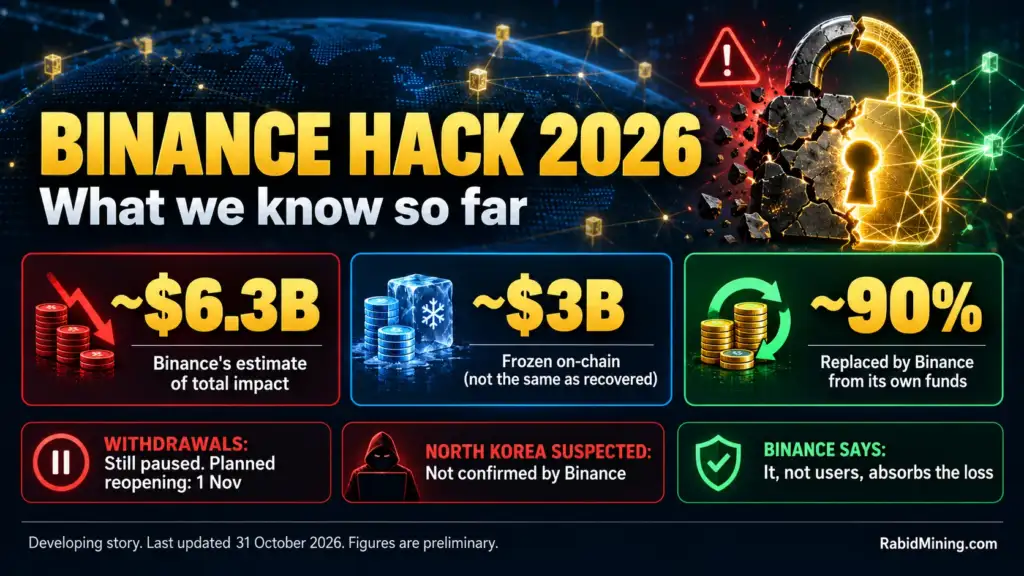
The Binance hack is the biggest story in crypto right now, and the numbers have changed a lot since it broke. On the evening of 29 October 2026, billions of dollars started leaving wallets linked to the world’s largest crypto exchange. Binance now estimates the total impact at about $6.3 billion, says about $3 billion has been frozen, and says it has already replaced about 90% of the stolen crypto from its own funds. Here is what is confirmed, what is still only an investigator’s claim, and what it means if you hold crypto or mine and get paid out to an exchange.
Developing story. Last updated 31 October 2026, late afternoon UTC. Figures differ between sources and Binance says it is still gathering facts, so treat every dollar amount below as preliminary. I will keep updating this post, and every change is listed in the update log near the bottom.
The short version
- What happened: Binance hot wallets were drained across about 10 blockchains, mostly within roughly 20 minutes, starting on the evening of 29 October (UTC).
- How much: Binance estimates the total impact at about $6.3 billion. TRM Labs puts the original outflows at about $6.36 billion, Chainalysis at about $5.9 billion at the time of the theft (its CEO later said $6.4 billion). Early estimates of $2.8 billion to $5.8 billion were incomplete.
- What Binance says: “Binance will absorb the financial impact of these stolen funds, not our users.” It says it has replaced about 90% of the stolen crypto, and that BTC, ETH, USDT, BNB, SOL, USDC, XRP, USD1, RLUSD and ZEC are fully backed. The money comes from company funds, part of its futures insurance fund and part of SAFU.
- Frozen: Binance says about $3 billion is verified frozen on-chain. Frozen is not the same as recovered.
- Withdrawals: still paused at last check. Binance says deposits are back to normal and it is on track to reopen withdrawals on Sunday 1 November, subject to security checks and final confirmation. That is a plan, not a confirmed reopening.
- Cause: Binance’s early findings point to a compromised laptop belonging to a DevOps engineer, and it says it found no evidence of a wallet private key leak. Co-CEO Richard Teng has since said investigators found breach points beyond that laptop, and Binance has not explained the full attack path yet.
- Who: TRM Labs attributes it to North Korea’s TraderTraitor group with “high confidence,” and Chainalysis and ZachXBT also point there. Binance has not confirmed that, and when asked, President Trump said “we don’t know.”
What Binance has actually said
Binance started out saying it was “aware of reports of a potential security issue and actively investigating,” and that user funds were completely safe. Reporters noted that the statement was edited several times through the night. Founder Changpeng Zhao (CZ), who stepped down as CEO in 2023 but is still a major shareholder, wrote “It does look like a hack on Binance.”
Since then Binance has gone much further. It now says:
- The total impact is estimated at about $6.3 billion, and it has worked with blockchain partners to freeze about $3 billion on-chain.
- “Binance will absorb the financial impact of these stolen funds, not our users.” It has set aside more than $6.34 billion of company funds, including $5 billion held in the affected cryptocurrencies, and is funding replacements from its corporate treasury, part of its futures insurance fund and a partial deployment of SAFU. It says it will restore SAFU to about $1 billion.
- As of 31 October it says about 90% of the stolen crypto has been replaced (up from about 80%), and that BTC, ETH, USDT, BNB, SOL, USDC, XRP, USD1, RLUSD and ZEC are fully backed. The last 10% is less liquid tokens it is still buying on public markets and over the counter. This is replacement, not recovery from the attacker.
- Initial findings point to a compromised DevOps engineer’s laptop that gave an attacker access to a service container to submit unauthorized withdrawals. It found no evidence of a wallet private key leak. A later update mentioned additional points of breach.
- Co-CEO Richard Teng said the attack was not a single “one-click” action, and that the investigation “has not attributed responsibility to any individual.”
- Co-founder Yi He said Binance is buying altcoins to match the stolen tokens ahead of an updated Proof of Reserves, and Binance later said it holds about $5 billion in matching tokens in custody.
- It published an interim Proof of Reserves snapshot (taken at midnight UTC on 31 October) showing coverage of 100% or more for the named tokens. The full cryptographic proof, which lets users check their balances are included, is expected by 3 November. A technical post-mortem will come once the investigation is complete, with no date yet.
- It is working with law enforcement. Binance.US says its platform was not affected.
Timeline (UTC)
| Time | What was reported |
|---|---|
| 28 Oct | The attacker’s setup address receives small amounts of ETH from Tornado Cash |
| 29 Oct, about 20:05–20:24 | The main outflow burst begins (TRM Labs says about 20:05; on-chain analysts flagged the big Ethereum transfer at 20:24). Most funds move within about 20 minutes |
| 21:05–21:25 | Tether and Circle start freezing funds; CZ says it “does look like a hack”; Binance posts its first statement |
| 22:32 | Aave freezes markets after the exploiter borrows about $44.6 million |
| 23:35 | Binance reports $2.54 billion in verified frozen assets |
| 30 Oct, 00:07 | Binance temporarily suspends deposits |
| 00:52 | Binance raises its verified frozen total to $3 billion |
| 02:25 | Binance points to a compromised DevOps engineer’s laptop and puts the total impact at about $6.3 billion |
| 04:17 | Binance says withdrawals should resume within 48 hours |
| 05:01 | Chainalysis CEO Jonathan Levin links the attack to TraderTraitor |
| 08:37 | Binance reports additional points of breach; withdrawals “on track” to resume in 45 hours |
| 10:09 | Chainalysis reports apparent automated laundering of the stolen funds |
| 10:55 | Binance says it has set aside more than $6.34 billion of company funds for losses |
| 12:41 | Binance says it holds about $5 billion in matching tokens in custody |
| 31 Oct (morning to afternoon) | Binance says about 90% of the stolen crypto is replaced, publishes an interim Proof of Reserves, and says withdrawals are on track for Sunday 1 November. Teng says investigators found breach points beyond the laptop |
How much was taken in the Binance hack?
The estimates have converged a lot since the first hours, when early counts looked only at Ethereum or at one set of wallets. Here is where they stand:
| Source | Estimate | Notes |
|---|---|---|
| Binance | about $6.3 billion | Its estimate of the total impact |
| TRM Labs | about $6.36 billion | Original outflows across 10 networks, at prices when the assets left |
| Chainalysis | about $5.9 billion, later $6.4 billion | $5.912 billion at the time of the theft; its CEO later cited $6.4 billion |
| Early estimates (Etherscan, Blockaid, Arkham, others) | $2.8 billion to $5.8 billion | Partial views of the outflows from the first hours |
Why do the figures differ? They depend on which wallets and chains are counted and on the prices used. Binance’s number is its own estimate and has not been independently audited, and it has not yet published a full breakdown of what was stolen, what is frozen and what has been recovered.
How did the Binance hack happen? What we know and what is a guess
Binance’s preliminary explanation is a compromised DevOps engineer’s laptop, which let the attacker reach an internal service container and submit unauthorized withdrawals. Binance says it found no evidence that a wallet private key leaked. A later update said it found additional points of breach but did not say where, and the investigation is ongoing.
On-chain, security firm Blockaid says the Binance 14 Ethereum hot wallet received a transaction with 50 EIP-7702 authorizations, one of which activated a delegation to malicious code. EIP-7702 is an Ethereum feature live since the Pectra upgrade in May 2025 that lets a wallet hand control to a smart contract. Other transfers were ordinary signed transactions. Reports also say the attacker’s setup address got small Tornado Cash withdrawals and tested malicious code before the main attack.
Teng said this was not a single “one-click” action. The full technical story should come in Binance’s promised post-mortem, so treat anything beyond the above as speculation until then.
Who is behind it? North Korea is suspected, not confirmed
TRM Labs attributes the attack to TraderTraitor, a North Korean state-linked group, with “high confidence,” based on what it calls on-chain and off-chain intelligence. It has not shared all of its evidence. Chainalysis CEO Jonathan Levin also considers TraderTraitor the likely perpetrator, and ZachXBT reportedly points to the stolen funds mixing with the address from Bitget’s earlier $388 million exploit. For context, the FBI attributed the 2025 Bybit theft to the same group.
Binance has not named an attacker. Teng said the investigation has not attributed responsibility to any individual, and President Trump, asked whether North Korea was behind it, said “we don’t know.” No government has confirmed the attribution on the record. This is investigators’ assessment, not a finding by Binance or law enforcement.
What was frozen, and what wasn’t
Binance says it has worked with partners to freeze about $3 billion on-chain, up from $2.54 billion the night before, and it says the figure may rise as investigators trace more funds. Several issuers took part:
- Tether: CEO Paolo Ardoino said more than 1.567 billion USDT was frozen early on. Other reports have given lower totals for Tether, so the issuer-by-issuer split is not settled.
- Circle: CEO Jeremy Allaire said more than 800 million USDC was frozen.
- Others: World Liberty Financial froze $27 million in USD1, Ripple froze RLUSD linked to the hack (amount not disclosed), and First Digital said it froze stolen FDUSD.
TRM Labs’ own tally of the freezes, using the issuers’ latest figures (about 1.77 billion USDT from Tether, about 825 million USDC from Circle, 40.5 million RLUSD from Ripple and 27.8 million USD1 from World Liberty Financial), comes to roughly $2.66 billion, a bit under Binance’s $3 billion. The snapshots differ by time, so expect the numbers to keep moving.
The catch: native ETH and BTC can’t be frozen the way stablecoins can. Frozen also doesn’t mean returned. A technical freeze can happen in minutes, but getting funds back to a victim can take months or years and depends on law enforcement and the issuers.
The attacker trying to cash out
Decrypt reported the attacker hunting for exit ramps. One wallet deposited USDT into Aave and borrowed ETH against it (about $44.6 million, per Cointelegraph’s live timeline), after which Aave froze its V3 markets on Ethereum mainnet, and Kamino on Solana paused some markets. Chainalysis has since reported apparent automated laundering of the funds, and TRM says the funds were spread across 10 networks, with a later wave reaching Avalanche and Polygon.
Market reaction
By about 01:19 UTC on 30 October (CoinGecko), Bitcoin was around $76,900, down about 4.9% on the day, BNB was down about 8% to roughly $693, and Ether was down about 5.7% to around $2,211. AAVE and UNI fell more than 10%. The Bitcoin Fear and Greed Index read 30 (“fear”), its lowest since August. Prices are moving fast, so check a live ticker. Early talk of a rotation into privacy coins like Monero is speculation, and no source says the stolen funds went there.
Is this the biggest crypto hack ever?
At Binance’s own estimate of about $6.3 billion, yes, by a wide margin. It is more than four times the 2025 Bybit theft, the previous record.
| Incident | Year | Amount |
|---|---|---|
| Binance | 2026 | about $6.3 billion (Binance’s estimate) |
| Bybit | 2025 | about $1.46 billion (FBI attributed it to North Korea) |
| Ronin Network | 2022 | $625 million |
| Poly Network | 2021 | $611 million |
| BNB Chain Bridge | 2022 | $570 million |
Will Binance users get their money?
Binance’s answer to who takes the loss is itself: “Binance will absorb the financial impact of these stolen funds, not our users.” It has set aside more than $6.34 billion of company funds (separate from the roughly $3 billion frozen) and says it has already bought back about 90% of what was taken, with the top tokens fully backed. The money is coming from its corporate treasury, part of its futures insurance fund and a partial use of SAFU, its emergency fund set up in 2018. SAFU was last reported at about 15,000 BTC (roughly $1 billion), only a fraction of the loss, and Binance says it will top it back up to about $1 billion.
Binance has published an interim Proof of Reserves snapshot showing coverage of 100% or more for the named tokens, and says the full proof will come by 3 November. A CoinDesk review also noted that wallets drained in the attack were among those Binance had listed as backing user holdings, which is why the full proof matters. The post-mortem has no date yet. All of this is Binance’s own reporting, so watch what the full proof shows. I have found no report of customers having their balances cut, but their access was paused while withdrawals were closed.
What this means for holders and miners
This section is my take, not data, and it is not financial advice.
- Don’t panic-click links. Every big incident brings a wave of fake “unlock your funds” messages on Telegram, WhatsApp and X. Only trust Binance’s official channels and never share account details or seed phrases.
- Check where your payouts go. If your miner or pool pays out to a Binance deposit address, remember that withdrawals can be paused for days. Consider sending payouts to a wallet you control and moving to an exchange only when you want to sell.
- Self-custody has a catch too. Coins held in your own wallet were not exposed to this event, but then you are the security team. Keep backups offline and never type your seed phrase into a website.
- Don’t spread your funds randomly. Moving money around in a panic, especially through unknown bridges or sites, is how people get hit twice.
- Be careful with the price talk. A big hack can move the market in either direction and nobody knows which way this one goes. Plan around your own risk and not around a tweet.
What we still don’t know
- The full technical cause, including the “additional points of breach” Binance mentioned.
- Whether the North Korea attribution holds up, and whether Binance or law enforcement will confirm it.
- The final loss figure and a full reconciliation of stolen, frozen and recovered assets.
- Whether withdrawals actually reopen on Sunday 1 November as Binance plans, and whether every network comes back at once.
- What the full Proof of Reserves (expected by 3 November) and the post-mortem show, and when the post-mortem lands.
- How much of the frozen money makes it back, and where the rest of the funds end up.
Binance hack update log
Newest first. Each entry is the date this post was updated and what changed.
| Updated | What changed |
|---|---|
| 31 October 2026, late afternoon UTC | Binance says about 90% of the stolen crypto is replaced and the top tokens are fully backed, and that it, not users, absorbs the loss. Interim Proof of Reserves published, full proof due by 3 November. Withdrawals still paused, planned to reopen Sunday 1 November. Teng says breach points go beyond the laptop. Trump says “we don’t know” if North Korea did it. TRM’s freeze tally is about $2.66 billion. |
| 30 October 2026, midday UTC | Post rewritten. Binance estimates the total impact at about $6.3 billion and says about $3 billion is frozen. Binance points to a compromised DevOps engineer’s laptop. TRM Labs and Chainalysis attribute the attack to North Korea’s TraderTraitor group, which Binance has not confirmed. Binance sets aside more than $6.34 billion in company funds and expects withdrawals to resume within about 48 hours. |
| 29 October 2026, late evening UTC | Post published. Early estimates ranged from $2.8 billion to $5.8 billion. Binance said it was investigating a security issue and that user funds were safe. Tether and Circle froze funds, and Binance reported $2.54 billion frozen. |
Sources
- CoinDesk: Binance says it has replaced 90% of stolen crypto after massive $6.3 billion breach
- CNBC: Binance says 90% of $6.3 billion hack losses are now covered, plans to resume withdrawals Sunday
- ABC News: Binance estimates security breach impact at $6.3 billion
- Cointelegraph: Live updates, Binance losses estimated at $6.3B
- crypto.news: Binance hack, what happened and where the $6.3 billion went
- CNBC: Billions in crypto frozen in Binance hack, here’s what happens next
- The Block: Binance investigating hack as suspicious outflows reach up to $5.8 billion
- TechCrunch: Binance pauses withdrawals as hackers suspected of stealing billions in crypto
- CryptoTicker: North Korea behind the Binance hack? What we know
- Decrypt via Yahoo Finance: Binance hacker hunts for exit ramps as DeFi exchanges pause markets
Information current as of 31 October 2026, late afternoon UTC, and likely to change as the investigation continues. This is news and commentary, not investment or financial advice.